
An interior business can have beautiful project photographs and still receive very few website enquiries. This happens because people looking for an interior designer are not simply browsing for design ideas. Once they become interested in a studio, they start checking whether that business is actually suitable for their project.
A homeowner in Noida, for example, may first discover an interior studio through Instagram. After seeing a few attractive projects, they visit the website to find out what the studio does, whether it works in Noida, what types of homes it handles, and how they can speak to the team. The website therefore becomes the place where curiosity turns into a decision.
That is the real online enquiry journey for interior businesses. It is not one action. It is a series of small decisions made by the visitor before they are comfortable enough to contact the business.
This is why website design for interior designers in Delhi NCR should not be treated simply as a visual exercise. The photographs, project pages, service information, trust signals, and contact options should work together so that visitors always know what to do next.
Step 1: Make the portfolio useful, not just attractive
Interior websites naturally depend heavily on images. People want to see the quality of the work before they consider contacting a designer. However, a large collection of photographs does not automatically make a portfolio useful.
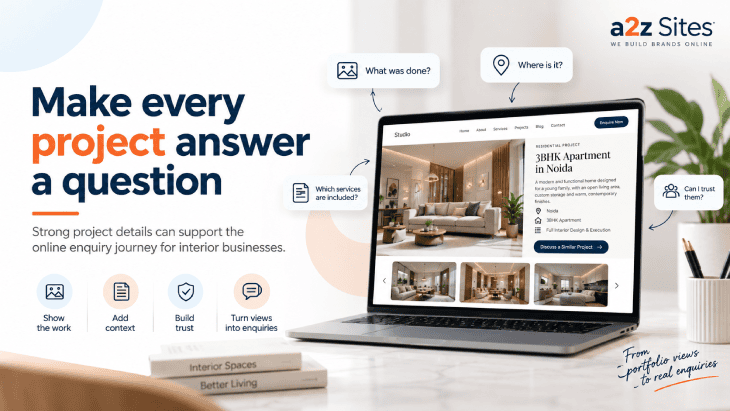
Visitors want some context around the work they are seeing. A project can mention whether it was a 3BHK apartment in Noida, a villa in Gurugram, a residential renovation in Delhi or an office interior project. A short explanation of the brief and services provided can make the photographs much more meaningful.
For an interior design portfolio website, projects can also be organised in a way that matches how customers search. Residential projects, commercial projects, kitchens, bedrooms or complete home interiors can have separate groupings when the business has enough work to support them.
This makes it easier for someone to find a project that looks similar to their own requirement. It also gives the visitor a reason to explore more of the website instead of looking at one photograph and leaving.
What should a project page tell a potential client?
A project page does not need a long case study. It should simply provide enough information for someone to understand what they are looking at and why it is relevant to them.
Useful details can include the property type, location, project scope, major requirements, selected photographs, and the services provided. If the client has approved a testimonial or project description, that can add another layer of trust.
For an interior designer website design project, this approach is more useful than filling every page with decorative elements. The website should help a potential client imagine what working with the studio could look like.
Step 2: Explain your services before asking for an enquiry
After viewing a project, the next question is usually simple: “Can this studio do what I need?”
Interior businesses often offer several services, but these are sometimes hidden behind broad phrases such as “complete interior solutions”. A visitor may still not understand whether the business handles only design or also execution, renovation, modular kitchens, furniture, space planning, or other requirements.
Clear website design services should make these differences easy to understand. Each important service can have a short explanation covering what is included, who it is suitable for, and what the client can expect.
This is particularly useful for visitors who are still comparing different interior studios. If they can understand your services without making a phone call, they are more likely to continue exploring the website.
The same principle applies when choosing a website design agency. The agency should first understand what the interior business actually sells and then structure the website around those services. A visually attractive website with unclear offerings does not solve the customer’s problem.
Step 3: Give visitors enough reasons to trust you
Hiring an interior designer involves money, time, and access to someone’s home or workplace. Because of this, visitors often look for proof before making an enquiry. They may want to know who runs the studio, how much experience the team has, where it has completed projects, and what previous clients have said.
A website can bring these trust signals together in one place. Real project photographs, client testimonials, team information, relevant experience and clearly stated service areas can all help reduce uncertainty.
This is one area where an interior design website can provide something that a social media profile cannot provide as easily. Instagram may show the latest project, but the website can organise the complete story of the business.
For example, a potential client from Gurugram may discover a studio through social media, visit its website, see three relevant projects, read about the services, and then check the contact section. Each piece of information answers another question in the visitor’s mind.
That is why trust should be built before the enquiry form appears. Asking someone to “Book a consultation” without first giving them enough information can feel premature.
Step 4: Make Delhi NCR coverage clear
Delhi NCR is not one single local market. An interior studio may primarily serve Delhi, while another may focus on Noida or Gurugram. Some businesses may also take projects in Ghaziabad or Faridabad.
A potential client should not have to guess whether the studio works in their area. The website can mention its service locations naturally on the homepage, relevant service pages, project descriptions, and contact page.
This matters for website design for interior designers in Delhi NCR because location is often part of the customer’s decision. Someone searching for an interior designer for a home in Noida may quickly leave if the website gives no indication that the studio takes projects there.
The location information should still sound natural. There is no need to repeat “Delhi NCR” in every paragraph simply for search engines. Clear information written for the customer is more useful.
Step 5: Remove friction from the final enquiry
Once visitors have seen relevant work and found enough information to trust the studio, the next step should be easy. This is where many otherwise good websites lose potential clients.
A visitor may be ready to ask about a project but cannot find the phone number. Another may prefer WhatsApp but only see a long contact form. Someone browsing on a mobile phone may not want to type a detailed message just to ask whether the studio serves their location.
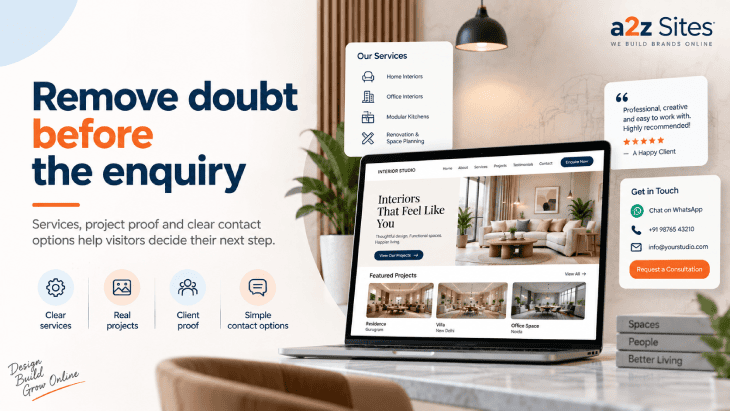
A better approach is to offer simple options such as a WhatsApp CTA, phone number, and short enquiry form. The form can ask for useful information such as project type, location, and approximate requirements without making the visitor complete a long questionnaire.
This is a key part of the online enquiry journey for interior businesses because the visitor has already done most of the decision-making. The website should not make the final step harder than necessary.
For businesses considering website design services, this is an important point to discuss before development begins. The contact mechanism should match how the target customers actually prefer to communicate.
What should an interior website include?
A practical website for an interior business does not need every possible feature. It needs the right information in the right order.
A basic structure could look like this:
| Website section | What it should help the visitor understand |
| Homepage | What the studio does and where it works |
| Portfolio | What kind of projects it has completed |
| Project pages | What was done and where |
| Services | What the client can hire the studio for |
| About | Who is behind the business |
| Testimonials | What previous clients experienced |
| Contact | How to start an enquiry |
| WhatsApp CTA | How to start a quick conversation |
This structure is particularly useful for interior design website development because it connects the visual side of the business with the practical questions customers have before making contact.
It also gives the business a better foundation for future content. New projects, services, and testimonials can be added without rebuilding the entire website.
What does a2z Sites include in its website plans?
For interior businesses planning a new website, a2z Sites offers website plans starting at ₹29,000 + GST. The available plans are designed for different website sizes, with up to 5, 10, or 15 pages.
The Launch plan starts at ₹29,000 + 18% GST and includes up to 5 pages, while Grow is ₹39,000 + 18% GST for up to 10 pages. Scale is ₹59,000 + 18% GST for up to 15 pages. Estimated delivery is around 2 to 4 weeks depending on the selected plan and how quickly the required content and approvals are provided.
Portfolio setup is included in all three plans, which makes the packages relevant for interior businesses that need to showcase completed projects. Contact forms and WhatsApp CTAs are also included, giving visitors direct ways to make an enquiry.
The plans differ in other areas too. Grow and Scale include website speed optimisation and Google Analytics setup, while Scale includes a blog or news section with CMS functionality. Post-launch support ranges from 30 to 60 days depending on the plan.
What is included and what may cost extra?
The starting price should always be understood alongside the scope. A website package covers the agreed website pages and features, but it does not mean that every possible requirement is automatically included.
For example, the standard plans do not include unlimited custom development or new features added after the agreed scope. Additional pages or major changes may require additional work and pricing.
The business also needs to provide its content, photographs, branding materials, and approvals within the project process. For an interior studio, this can be particularly important because selecting and preparing project photographs can take time.
A web design and development company in Delhi should therefore discuss the actual requirements before recommending a package. The cheapest plan is not necessarily the best option if the business has a large portfolio, several service categories, and many locations to explain.
Which website plan could suit an interior business?
A new interior studio with only a few strong projects may not need a large website at the beginning. A focused five-page website can provide the essential information while leaving room to expand later.
An established studio with multiple services and a larger portfolio may need more pages. The Grow plan can provide space for additional service and project content without making the website unnecessarily large.
A larger interior business with several project categories, services, and supporting content may find the Scale plan more suitable. The blog functionality can also provide room for future articles about projects, design ideas, and customer questions.
The important point is to choose based on what customers need to know, rather than choosing a package simply because it has more pages.
Compare the website plans for interior designers to see what each includes.
Use this checklist before approving your website
Before launching an interior business website, check it as if you were a first-time customer.
| Question | Yes / No |
| Can I understand the main service within a few seconds? | |
| Can I find projects similar to what I need? | |
| Does each important project have useful context? | |
| Can I understand exactly what services are offered? | |
| Can I see where the business works? | |
| Can I find genuine trust signals? | |
| Can I contact the business easily on mobile? | |
| Is WhatsApp easy to find? | |
| Is the enquiry form short and relevant? |
If several answers are “No”, adding more photographs or increasing website traffic may not solve the problem. The issue may be that visitors are not getting enough information to take the next step.
This is where interior design website development should focus on the complete customer journey rather than only the appearance of the website.
Turn portfolio interest into a real conversation
The best interior business websites do not force visitors to enquire immediately. They give them enough useful information to reach that decision themselves.
A visitor sees a project, finds something similar to their requirement, understands the services, checks the location, sees proof of previous work, and finally finds an easy way to contact the studio. None of these steps is complicated, but together they create a smoother online enquiry journey for interior businesses.
For an interior studio in Delhi NCR, this matters because the website often sits between discovery and the first real conversation. A strong portfolio can bring someone in, but clear information and an easy enquiry process can give them a reason to stay.
If your current website gets portfolio views but very few enquiries, it may be worth reviewing the journey instead of simply adding more pages or photographs. Contact us with your website or current portfolio and ask the team to review whether your website is helping visitors move towards an enquiry.