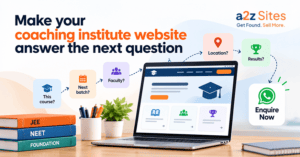
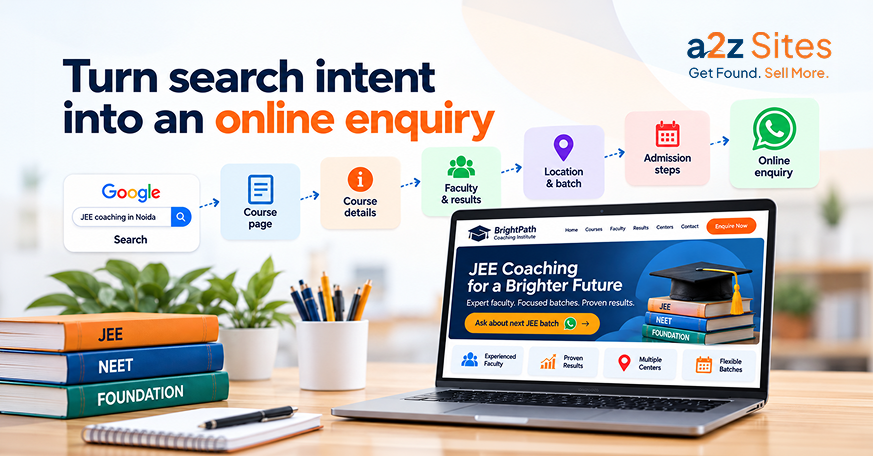
A student or parent may start with a Google search such as “JEE coaching near me” or “best NEET coaching in Noida.” They may then visit two or three websites, check courses, look at results, compare locations, and finally open WhatsApp.
The important point is that the online enquiry does not begin when someone clicks the WhatsApp button. It begins much earlier, when the visitor decides whether your institute is worth considering.
If the website does not answer an important question at any stage, the visitor may leave without contacting you. This makes the website part of the admission process, not just an online brochure.
For coaching institutes in Delhi NCR, this matters even more because students can compare institutes across Delhi, Noida, Gurugram, Ghaziabad, and Faridabad. Your website needs to make the decision easier without making the visitor work too hard.
What does the online enquiry journey look like?
A simple coaching admission journey can look like this:
Search → relevant course page → questions → trust check → practical details → enquiry option → WhatsApp conversation
Every stage has a different purpose.
The search result should take visitors to useful information. The course page should answer their basic questions. Trust information should reduce doubt. Practical details should remove uncertainty. Finally, the enquiry option should make contacting the institute simple.
A coaching institute website should therefore be planned around the questions visitors ask, rather than only around the information the institute wants to publish.
1. Start with the search that brings the visitor
The first step is understanding why someone has reached the website. A student searching for “JEE coaching in Noida” has a different need from a parent searching for “coaching institute fees in Delhi.” Someone searching for “NEET coaching near me” may care strongly about location.
The page they reach should match that intent.
If someone searches for a particular course, sending them to a generic home page and making them search again creates unnecessary friction. A relevant course page can give them a much faster answer.
This is one reason coaching website design should consider search intent while planning the website structure. Pages should have a clear purpose instead of simply increasing the page count.
2. Use the course page to answer real questions
Once a visitor reaches the right course page, they usually want to know whether the course is suitable for them. A useful course page should answer questions such as:
- Who is the course for?
- What subjects are covered?
- How long does the course run?
- When does the next batch start?
- What is the class format?
- Where are classes held?
- What support is provided?
- How can the student ask about fees or admission?
This information makes the online enquiry more specific.
Instead of sending a WhatsApp message saying, “Please give details,” a visitor may ask, “When does the next Class 12 NEET batch start?” That gives the admission team a much clearer starting point.
A short admission enquiry form can also be placed after the main course information. It should support the decision, not interrupt it.
3. Help visitors compare without overwhelming them
Students and parents often compare more than one course before making an online enquiry. You do not need to create a long comparison of competitors. Instead, make your own information easy to compare.
For example, if an institute has three programs, show:
| Information | Course A | Course B | Course C |
| Suitable for | Class 11 | Class 12 | Droppers |
| Duration | 1 year | 1 year | 1 year |
| Format | Classroom | Classroom | Classroom |
| Batch | Morning | Evening | Morning |
| Location | Noida | Noida | Noida |
| Enquiry | Ask about batch | Ask about batch | Ask about batch |
The purpose is not to fill the page with information. It is to help the visitor understand which option may be right for them.
4. Build trust before asking for the enquiry
A student may understand the course and still hesitate. This is where proof becomes important.
Relevant trust information can include:
- Faculty profiles
- Genuine student results
- Testimonials
- Student achievements
- Center photographs
- Years of operation
- Course-specific experience
- Clear contact information
Do not keep all this information hidden on an About page.
If a course page is asking a parent to enquire, some relevant proof should appear on that page too. A short results section can link to a detailed results page. A faculty summary can link to the complete faculty section.
This helps make an online enquiry a more informed decision instead of a blind contact.
5. Remove practical questions before they become objections
Some visitors leave not because they dislike the course, but because they cannot find a simple answer.
Where is the center?
When is the next batch?
Are classes available on weekends?
How long is the course?
How do I apply?
Who should I contact?
These questions should be easy to answer.
For Delhi NCR institutes, location information is especially important. If an institute has branches in Noida and Gurugram, visitors should be able to identify the relevant center without going through several pages.
Google Maps, phone numbers, batch information, admission instructions, and clear contact options can all reduce unnecessary hesitation.
How should the website move visitors toward WhatsApp?
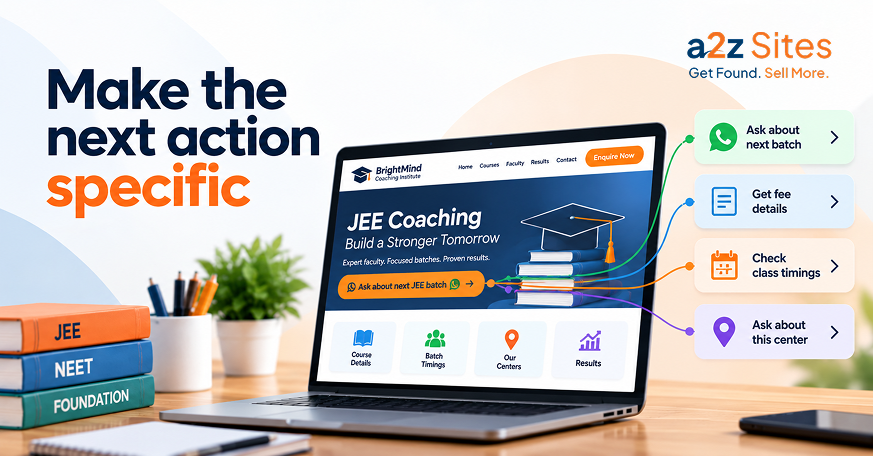
A WhatsApp button should not feel like a sudden sales request. The CTA should connect with what the visitor has just been reading.
For a JEE course page, “Ask about the next JEE batch” is more useful than simply saying “Contact us.”
For an admissions page, “Ask about admission” may be more appropriate.
For a location page, “Ask about batches at this center” gives the visitor a clear reason to start the conversation.
The same idea applies to forms. Ask only for useful information such as:
- Name
- Phone number
- Course of interest
- Preferred location
- Short message
The visitor should understand what will happen after submitting the form.
What should happen after the WhatsApp click?
The website should prepare the admission team for the conversation. A useful approach is to create a prefilled WhatsApp message based on the page the visitor is viewing.
For example:
“I want to know about the next JEE batch at your Noida center.”
This is better than a completely blank WhatsApp chat because the admission team immediately knows the course and location involved.
It also reduces repeated questions. The visitor has already given some context, and the counsellor can move directly to the next relevant question.
This is where the website and the admission team need to work together. A good website can start the conversation, but the response after the message still matters.
What should an online enquiry page include?
If the institute has a dedicated enquiry or admissions page, keep it focused. It can include:
- Course selection
- Batch information
- Location options
- Admission steps
- Short enquiry form
- WhatsApp CTA
- Phone number
- Expected response information
- Links to important course pages
Do not turn this page into another long company profile.
The visitor has already shown interest. The job of this page is to make the next step easy.
A strong online enquiry page can also explain what happens after submission. Even a simple statement such as “Our admission team will contact you about your selected course” gives visitors more confidence.
How a2z Sites can support the journey
A website project should start with the business, audience, goals, website structure, and user journey. a2z Sites describes a process that includes understanding requirements, planning the website structure and user experience, developing the approved design, testing, launching, and providing post-launch support. A web design and development company in Delhi can use this process to build a website around the way prospective students actually make decisions.
For coaching institutes, this means the website can be structured around courses, faculty, results, locations, admissions, and enquiry points instead of simply putting all information into a few generic pages.
The current a2z Sites website plans are:
| Plan | Price | Pages | Estimated delivery |
| Launch | ₹29,000 + 18% GST | Up to 5 | About 2 weeks |
| Grow | ₹39,000 + 18% GST | Up to 10 | About 3 weeks |
| Scale | ₹59,000 + 18% GST | Up to 15 | About 4 weeks |
All three plans include Google Maps integration, social media integration, a contact form, and a WhatsApp CTA. Launch includes basic SEO. Grow and Scale include advanced SEO, speed optimization, and Google Analytics. Scale also includes a blog. Post-launch support is 30 days for Launch, 45 days for Grow, and 60 days for Scale.
Additional pages, major changes, custom functionality, integrations, ecommerce requirements, and other work outside the selected package may require separate pricing. These requirements should be clarified before the project begins.
Which plan may suit a coaching institute?
A small coaching center with a few important courses may be able to work with Launch if five pages are enough to cover its main information.
Grow can be more suitable when the institute needs separate course pages, faculty information, results, admissions content, and other sections.
Scale may make sense for a larger institute that needs up to 15 pages and wants a blog for ongoing educational content.
When comparing website design services, do not compare only the starting price. Check the number of pages, SEO setup, speed optimization, analytics, contact options, support period, delivery timeline, and what happens when you need something outside the package.
The cheapest website is not always the most useful website. The better question is whether the selected plan supports the admission journey you want to create.
What technical support may be needed?
Some coaching institutes need more than standard pages and forms.
For example, you may want the website to connect with a CRM, create a custom admission workflow, integrate a specific tool, or support more complex functionality.
A web development company can be useful when the project needs this type of custom technical work.
However, not every coaching institute needs custom development. If the requirement is mainly to explain courses, show faculty and results, provide location details, and generate enquiries, a standard business website may be enough.
The important thing is to identify these requirements before choosing a package.
A practical online enquiry journey checklist
Before launching the website, check the complete path:
- Can a visitor reach the correct course page from Google?
- Does each major course page answer common student and parent questions?
- Can visitors find batch timings quickly?
- Are locations and Google Maps easy to find?
- Is genuine proof shown before the enquiry CTA?
- Does the WhatsApp CTA relate to the page?
- Is the enquiry form short?
- Is the website easy to use on a phone?
- Does the WhatsApp message provide useful context?
- Does the admission team know what information the visitor has already seen?
- Does the visitor know what happens after submitting an enquiry?
If several answers are no, adding more pages may not solve the problem. Improving the existing journey may be more useful.
Who is this approach suitable for?
This approach is suitable for coaching institutes that depend on student and parent enquiries and want their website to support admissions.
It is less necessary for an institute that only needs a basic online profile with its address, phone number, and a short description.
It also requires the institute to keep its information updated. A beautifully designed website cannot help much if old batch timings, outdated courses, or incorrect locations remain online.
The website and the admission team should also follow the same process. If the website promises a quick response but enquiries are answered after several days, the problem is no longer only the website.
Conclusion
An online enquiry does not begin with a WhatsApp button. It begins when a student or parent searches for a course and decides to continue exploring your institute.
The website should answer questions at every stage, from course suitability and batch details to faculty, results, location, and admission. When these steps connect properly, the visitor reaches WhatsApp with more confidence and better questions.
For coaching institutes in Delhi NCR, the goal should not simply be to get more messages. It should be to create a clearer journey that helps the right students reach the admissions team with less confusion.
Want to improve your website’s student enquiry journey? Share your current website, courses, locations, and admission goals with us and discuss which pages or CTAs should change.