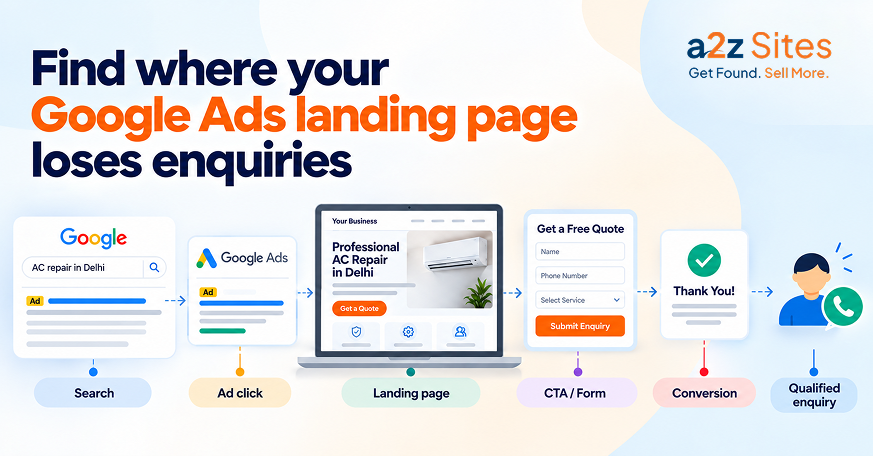
People who arrive through Google Ads usually have a specific reason for clicking. They may be looking for a service, a local provider, a product, a price, or a quick solution. The landing page should continue that journey and make the next step clear as well.
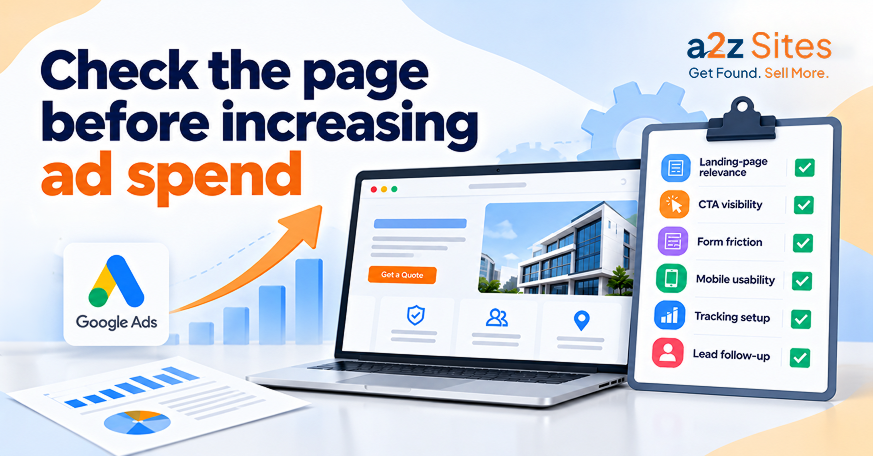
Check whether the search term, ad copy, headline, offer, CTA, form, trust signals, and conversion tracking support the same objective.
For example, an ad may promote a specific service in Delhi, but the click may lead to a general page covering several services and locations. The visitor then has to search for the information they expected to see. That extra effort can reduce enquiries even when the ad itself is relevant.
Where the enquiry journey commonly breaks
The page does not match the ad
The visitor should immediately see a connection between the search, the ad, and the page. If the ad mentions a service, location, offer, or benefit, the landing page should address that same point.
Sending paid traffic to a broad homepage can create unnecessary friction. Someone searching for a specific service should not have to navigate through several categories before finding it.
The first screen is unclear
The first section should make the offer and next action clear.
A vague headline, buried offer, or hard-to-find CTA can cause visitors to leave before they reach the useful information lower on the page. The first screen does not need every detail. It needs enough clarity to encourage the next step.
There are too many choices
A paid-traffic page should have one clear primary action. Competing buttons and unrelated navigation can divide attention.
Match the primary action to the campaign goal. Make calling easy for call campaigns and keep the enquiry form visible for lead-generation campaigns.
The form creates friction
A form should collect information that is genuinely useful at the enquiry stage. A visitor asking for a consultation may not need a long questionnaire before speaking with the business.
Review every field and ask whether it helps the sales team qualify the enquiry. If a field is necessary, explain why it is required.
Trust appears too late
Visitors often need evidence before contacting a business. Useful proof can include customer reviews, case studies, certifications, recognizable clients, guarantees, or clear contact details.
Use relevant proof near the decision point rather than filling the page with badges.
Mobile experience is weak
Local and service businesses can receive substantial mobile traffic. Check the page on an actual phone and test the enquiry process.
Review button size, form fields, spacing, image loading, click-to-call options, speed, and how easily visitors find the main offer.
Conversion tracking is incomplete
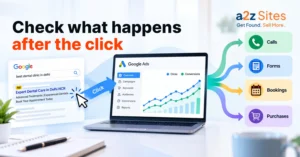
Clicks alone do not tell you whether advertising is producing business enquiries. Important actions such as form submissions, calls, bookings, purchases, or other defined lead actions should be tracked correctly.
Check tracking before changing budgets, because missing or duplicated conversions can distort campaign decisions.
Follow-up is slow or inconsistent
Check who receives leads, how quickly they are contacted, and whether missed calls are returned.
A low enquiry-to-customer rate may require a sales follow-up review.
A practical Google Ads landing page audit checklist
| Area | What to check |
| Search intent | Does the page answer the reason behind the search? |
| Ad relevance | Does the page continue the promise made in the ad? |
| Headline | Is the offer clear immediately? |
| CTA | Is the next action obvious and easy? |
| Form | Are unnecessary fields creating friction? |
| Trust | Is relevant proof placed near the decision point? |
| Mobile UX | Can visitors read, call, and submit easily? |
| Speed | Does the page load quickly enough? |
| Tracking | Are important conversions recorded correctly? |
| Follow-up | Are new enquiries received and handled promptly? |
What a Google Ads expert in Delhi should review before increasing spend
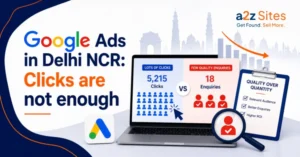
When a campaign receives clicks but produces disappointing enquiries, increasing the budget is not automatically the answer. Review search terms, ads, landing pages, conversion actions, and lead quality together.
This is also where Google Ads management services should involve more than bid changes. Campaign optimization can identify weak search terms and ads, while a landing page review can identify problems after the click.
If you are comparing a PPC company in Delhi, ask whether its process includes conversion tracking, landing-page recommendations, search-term analysis, reporting, and a clear method for connecting advertising data with actual enquiries.
a2z Sites Google Ads management pricing and landing-page scope
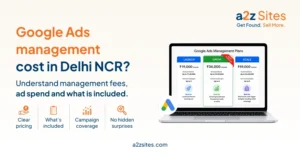
For businesses comparing management options, a2z Sites lists three Google Ads management plans. Launch is ₹19,000 per month, Grow is ₹34,000, and Scale is ₹59,000. An additional 18% GST applies. Media spend is separate and paid directly to Google.
Launch covers ad spend up to ₹1,20,000 per month and up to two active campaigns. Grow covers up to ₹3,00,000 and up to four active campaigns. Scale covers up to ₹6,00,000 and up to eight active campaigns.
Landing-page recommendations are included in all three plans. Launch includes basic recommendations, Grow includes recommendations every two weeks, and Scale includes ongoing recommendations. Conversion tracking audits and standard GA4/GTM conversion setup are included, subject to the required access.
Landing-page design and development are separate. Product-feed creation, call-tracking, CRM, media spend, taxes, and third-party tools are also separate where applicable.
Conclusion
A Google Ads landing page should be assessed as part of the complete enquiry journey, not as an isolated web page. Search intent, ad messaging, CTAs, forms, mobile usability, tracking, and lead follow-up can all influence the result.
Before increasing ad spend, identify where potential customers are being lost and address the most important issue first. This makes campaign data more useful and helps businesses use their budget carefully.