You may be posting on Instagram or Facebook several times a week, sharing festival greetings, product photographs, offers, tips, and customer feedback. Your followers may even like and share some of these posts. Yet, when you check your calls, WhatsApp messages, and website forms, there are hardly any new enquiries.
This does not automatically mean social media is not working. It may mean your content is attracting attention without giving people a clear reason to take the next step.
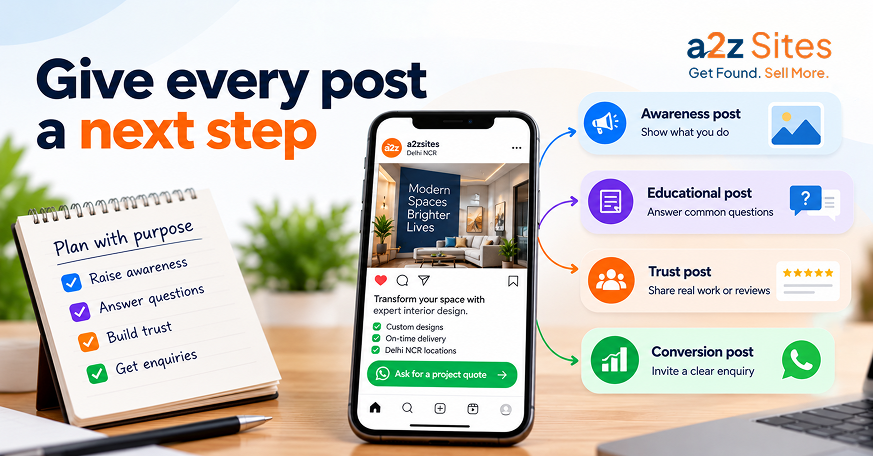
A useful social media plan connects every post to a business goal. Some posts should build awareness, others should answer customer questions, and some should encourage people to enquire. If every post has the same purpose, your page may remain active without helping people move closer to a purchase.
For small businesses in Delhi NCR, this distinction matters. A local service provider, coaching institute, clinic, retailer, or B2B company needs content that speaks to the questions its actual customers ask before spending money.
1. Your posts are active, but the purpose is unclear
Look at your last 12 posts. Can you explain what each one was meant to achieve?
If most of them simply announce a festival, share a quote, or say that your business offers quality service, your audience may not have enough information to make a decision.
For example, an electrical contractor can post a picture of a completed installation. However, a post explaining which homes may need a generator, what the installation process involves, and when to request an assessment gives potential customers more useful information.
A clothing retailer could show a product photograph, but a post explaining available sizes, fabric, styling, delivery, and how to order gives the customer a clearer next step.
Your social media plan should include a balance of content types:
- Awareness: Help new people understand what your business offers.
- Education: Answer questions and explain common problems.
- Trust: Show genuine reviews, work examples, credentials, or customer experiences.
- Conversion: Explain the offer and tell interested people how to enquire.
These categories can overlap, but every post should have a clear primary purpose.
2. Your content does not answer buying questions
A person may like your post without being ready to contact you. Before making an enquiry, they may want to know the price range, service coverage, delivery time, product features, process, or what makes your offer suitable for them.
If your content only talks about your business, potential customers must do the work of finding these answers themselves.
Review the questions your team receives on calls and WhatsApp. These questions are useful sources for content because they come directly from people considering your product or service.
For example, a Delhi NCR interior design business could answer questions about how project estimates are prepared, what affects the cost, what customers need to provide, and how long different stages may take.
A business selling a complex service could publish a simple process guide. A local retailer could explain how to choose between two product options.
The goal is not to turn every post into a sales pitch. It is to help people understand your offer before they contact you.
3. Your posts do not provide enough proof
People may understand what you sell and still hesitate to enquire. They may be unsure whether your business is reliable, experienced, or suitable for their needs.
This is where proof becomes important.
Useful proof can include:
- Genuine customer reviews and testimonials
- Before-and-after photographs, where relevant
- Examples of completed work
- Product demonstrations
- Short case studies with clear context
- Staff expertise or relevant qualifications
- Answers to common concerns
Use specific, accurate information rather than broad claims such as “best quality” or “number one service provider.” Explain what the customer received, what problem was addressed, or what they should look at in the example.
A strong social media plan makes proof a regular part of publishing, rather than saving every testimonial for an occasional promotional post.
Always obtain permission before sharing customer information, private messages, or identifiable photographs.
4. Your call to action is missing or too vague
A post may provide useful information but leave the reader unsure what to do next.
Phrases such as “Contact us today” or “Get in touch” are not always wrong, but they can be too general. A specific next step helps the reader understand what they can ask for.
Consider these examples:
| General CTA | More useful CTA |
| Contact us | Ask for a service estimate |
| Know more | WhatsApp us for available batches |
| Shop now | Message us to check sizes and colors |
| Get in touch | Share your requirement for a project quote |
| Call today | Ask whether your area is covered |
The CTA should match the post. If the content explains a service process, invite the reader to discuss their requirement. If it introduces a product, explain how to check availability or place an order.
Also check where the CTA appears. It should be easy to notice in the caption or creative, and the profile should provide a working contact method.
5. Your profile makes the next step difficult
Sometimes the post is not the problem. A person becomes interested, visits your profile, and cannot quickly work out what to do next.
Check your profile as if you were a new customer. Can someone understand what you offer, where you operate, and how to contact you without opening several posts?
Your profile should have:
- A clear description of your business and services
- The correct phone number, website, or WhatsApp link
- Relevant location or service-area details
- Pinned posts that explain your main offers or show useful proof
- Highlights or organized content for frequently asked questions, where supported
- A consistent and recognizable brand identity
For businesses serving Delhi, Noida, Gurugram, Ghaziabad, and Faridabad, clear service-area information can help visitors decide whether to contact you.
Keep the contact route simple. If a customer has to search for your phone number or send a message just to find your basic service details, some may leave before enquiring.
6. You measure likes but not enquiry activity
Likes and follower growth can help you understand audience response, but they do not show the complete picture.
If your business goal is enquiries, track actions that bring people closer to contacting you. Depending on the platform and your setup, these may include profile visits, link clicks, WhatsApp clicks, direct messages, form submissions, calls, and qualified leads.
Use a simple monthly table:
| What to track | What it helps you understand |
| Reach | How many accounts saw the content |
| Saves and shares | Whether people found it useful enough to keep or pass on |
| Profile visits | Whether the content created interest in your business |
| Link and WhatsApp clicks | Whether people tried to take the next step |
| Enquiries received | Whether people contacted your business |
| Qualified enquiries | Whether those enquiries matched your offer and service area |
| Enquiry source | Which post or channel helped generate the contact |
Do not judge a post only by its likes. A post with fewer likes may still be useful if it leads to relevant enquiries.
Where possible, use trackable links and ask new leads how they found you. Record the result consistently so you can compare performance over time.
How to audit your social media plan in 30 minutes
You do not need to redesign your entire strategy to identify the main gaps. Start by reviewing your recent content.
Step 1: Select 12 recent posts
Include a mix of educational, promotional, customer-focused, and general posts. Do not select only the posts that performed well.
Step 2: Give each post one main purpose
Mark whether it was designed for awareness, education, trust, or conversion. If you cannot identify a clear purpose, note that as a potential problem.
Step 3: Check the information and CTA
Ask whether the post answers a real customer question, provides a reason to trust the business, and offers a relevant next step.
Step 4: Review the result
Check the available reach, engagement, profile visits, link clicks, messages, and enquiries. Do not assume a post failed simply because it received few likes.
Step 5: Choose three improvements
For the next month, focus on three changes rather than changing everything at once. For example, you might add more customer proof, make CTAs specific, and track WhatsApp enquiries.
This simple audit gives your social media plan a clear starting point and helps you decide what to improve based on evidence.
What should a practical monthly content plan include?
A balanced calendar needs more than a list of publishing dates. It should show why each post exists and what action it supports.
For a local service business, a sample week could look like this:
| Day | Content idea | Main purpose | Suggested next step |
| Monday | Explain a common customer problem | Education | Read the service details |
| Wednesday | Show a completed project or genuine review | Trust | View related work |
| Friday | Answer a common pricing or process question | Consideration | Ask for an estimate |
| Saturday | Explain a specific offer or service area | Conversion | Send a WhatsApp enquiry |
This is only an example, not a rule that every business must follow. The right frequency depends on the audience, available material, business goals, and the quality of content you can maintain.
A useful social media plan also leaves room to repeat important messages in different formats. Someone who misses a carousel may notice a short video or a later post answering the same question from another angle.
How a2z Sites can help with social media management
If your team struggles to plan content, publish consistently, manage comments, or review results, working with a service provider may help establish a more organized process. When choosing a social media marketing agency, look for a team that connects content planning, audience engagement, and clear calls to action with your business’s enquiry goals.
a2z Sites offers organic social media management for businesses across Delhi NCR. The packages include content planning, creation, publishing, engagement support, and reporting, with the scope varying by plan. The team can help organize content around your business goals and the platforms that suit your audience.
What do the packages cost?
The current starting monthly packages are:
| Feature | Launch | Grow | Scale |
| Monthly price | ₹12,000 | ₹27,000 | ₹49,000 |
| Platforms managed | Up to 2 | Up to 2 | Up to 3 |
| Static or carousel posts per platform, per month | 4 | 8 | 12 |
| Short-form videos or Reels per platform, per month | Not included | 1 | 2 |
| Comment moderation | Weekly | Weekdays | Weekdays plus priority alerts |
| Content optimization | Monthly review | Twice monthly | Ongoing |
| Reporting | Monthly | Monthly | Dashboard and monthly review |
| Strategy call | Monthly | Monthly | Monthly |
The packages are starting scopes and can be customized after reviewing the business goals, platforms, content needs, and budget. Your approval is required before the monthly calendar is published.
Launch is designed for smaller businesses that need a consistent basic presence. Grow is intended for businesses using content to support leads or sales. Scale is for brands that need more frequent content and active optimization.
What is included, and what costs extra?
The packages include content planning, a monthly calendar, captions, publishing, and the specified content and reporting. Brand voice and platform SEO guidance is basic in Launch and advanced in Grow and Scale.
Some activities are not included in the base monthly price. Paid advertising is separate, and advertising spend is paid directly to the platform. You must supply approved videos for the video deliverables in Grow and Scale. Video production, AI-generated videos, influencer fees, giveaways, professional shoots, voiceovers, premium stock assets, and complex creative production may cost extra. Direct message management is also limited by plan and scope.
Before choosing a package, ask for a written scope covering platforms, post quantities, video requirements, engagement support, reporting, additional costs, and approval responsibilities.
You can review the current a2z Sites social media marketing services and pricing page to compare the published options.
Who needs professional social media support?
Professional support may suit a business that has clear products or services, knows its target customers, and needs help planning content and managing its social media activity consistently.
It can be useful for local service businesses, retailers, clinics, education providers, and B2B companies that want their pages to answer customer questions and support sales conversations.
It may not be the first priority for a business whose offer is unclear, whose contact details are incorrect, or whose team cannot respond to enquiries. Fixing these basics can be more important than publishing more content.
Social media management also cannot guarantee enquiries or sales. Results depend on the offer, audience, competition, content quality, response process, and other factors. A provider should explain the work and reporting included rather than promise a fixed number of leads without a clear basis.

Conclusion
A social media plan should help people move from noticing your business to understanding your offer and taking a useful next step. Posting regularly is only one part of that process. Clear content, genuine proof, specific calls to action, an easy contact route, and consistent tracking all matter.
Start by auditing your last 12 posts, identifying where the customer journey breaks, and choosing three improvements to test next month. If you need help planning and managing that process, speak with a2z Sites about a package that matches your goals and budget.
Want to make your social media more useful for your business? Send us your social media profile and explain what you sell, who you want to reach, and what enquiries you need. You can discuss the next steps through WhatsApp.